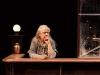
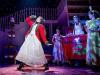
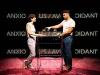
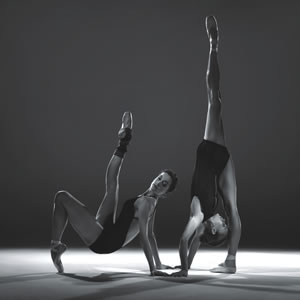
 Alice Topp & Frances Murphy. Photos - Tim Richardson
The Australian Ballet branched-out, into Bodytorque, 5 years ago. I'm not sure what the rationale was for it. Perhaps an attempt to expand the tiny subset of culture-vultures that attends ballet, by embracing modern dance, as well as classical. Bodytorque 2.2 (no praise be to Microsoft for leading arts organisations down the path of numbering new productions as it would software) should, then, be the sophisticated 'new movement in ballet' it's being cannily marketed as. Especially given the imprimatur of the organisation producing & presenting it. It is. But only, I think, to a limited extent. The tragedy is, the AB comes off looking a little like the poor, try-hard cousin of the Sydney Dance Company, Bangarra, Meryl Tankard, Tasdance or, to use an imported example of recent interest, Pilobolus. Indeed, overall, I found more inventiveness and originality in Short, Sweet & Dance. This isn't so much, I must stress, an embarrassing indictment of our national ballet; rather, a bolster to those other ventures, which have an agreeable tendency towards proving surpassing. But, the fact is, our flagship dance company should be closer to the top of any such list, if not triumph over it, by a measure of head and shoulders, so as to comfortably ensure, too, its surefootedness on the international stage.
I take no pleasure in relating this controversial opinion, which I fully expect to be howled down, especially if the semi-thunderous applause at the opening came from hands other than those of family, friends, colleagues and sponsors. Nor, I hasten to add, is my forthright claim intended to diminish near flawless performances, or the tremendous, body-breaking efforts invested, all-round: I'm by no means insensible to this; nor the emotional investment. it's just that, on the whole, I was underwhelmed and it would be less than honest to put any better spin on my reaction.
For whatever reason, the order of performances deviated from the printed programme. Perhaps this was merely to confuse and confound the reviewer. I think not, but it might've succeeded, in any case. I do clearly remember, however, that the first work was Robert Curran's Veiled In Flesh. Curran, of course, is a principal artist with the AB. In fact, he has been for around 7 years. As a choreographer, he's a toddler, but tends very much to betray that status, one suspects not least through a very particular empathy, since he works alongside them, founded on intimate knowledge of just what his dancers can do.
(In point of fact, Curran, despite only wearing his choreographer's hat a couple of years, is the old hand, this year; the others being, till now, virginal. Well, when I say virginal, even some virgins have a past. Reed Luplau, for example, was commissioned to choreograph two short works for the Sydney Dance Company, which he was invited to join, on the strength of the most catholic dance background, in 2005.)
Curran would seem to understand precisely, too, what George Balanchine meant, when he said, 'if you put two dancers on a stage, you've a relationship; three, and you've drama!'. Artistic director, David McAllister, was perspicacious in quoting this in the program notes, as that very tension pervades more than one of these works; very much underscored by gender imbalances. Curran's third palpable gift is his capacity for communicating concepts and even a sketched narrative. For example, in seeking, I think, to comment upon the role technology and the way we live our lives more generally has alienated us from each other and even ourselves, he has hit upon exactly the right motif: television screens, strewn across the stage, mesmerising their viewers, until such time as they happen upon the timelessly transformative power of touch. Curran cites several literary underpinnings for his ideas, including biblical (John 1:14) & Ondaatje, who inspired the title. Although his cinematic reference, to 2004's Crash, is perhaps the most explicative: 'we crash into each other, just so we can feel something'. Not a happy thought but, I suspect, an apt one.
My companion baulked at Alexander Scriabin's uncompromisingly 'analogue' music (played very tenderly by Duncan Salton, with highly-commendable cameos by dancers) being used to score a work so descriptive of the digital age. I took it, on the other hand, as very deliberate and effective counterpoint. The romantic, poetic, aesthetic and sensual was and is that with which we all need and seek, consciously, or otherwise, to connect and Scriabin shows the way, bringing an idiosyncratic, delicately atonal Chopinism, darkly coloured by his Russian roots.
Kat Chan & Alexis George's set and costume design put us right in the hear-and-now, with a slightly chilling, foreboding paranoia imparted that much more strongly, by dint of rather cold, bleak lighting, by John Berrett. Brooke Lockett was toy, object and, paradoxically, power-broker, between Kevin Jackson, Ty King-Wall & Jared Madden, with Laura Tong presenting as a rival romantic diversion. Couplings, partnerships, friendships, alliances, animosities and rivalries were complex and difficult to discern, yet I think this was the idea: all informed by the longing for lingering, enduring, meaningful connection, so eloquently effected by touch. The movement was fluid, though vigorous and athletic; at times, even aggressive. The sheer physicality was impressive: arresting attention, engaging the emotional, as well as calling to the primal and instinctual. Undeniably robust work (I'd even concede 'explosive', as per publicity), auguring well, also, for the individual and collective bravura of these lean, green, but mighty and 'mean', dancers.
At this point, I'm struggling to remember the consecution of works, so will go my own merry way, if you'll indulge me.
Bleecker, choreographed by Reed Luplau is, I take it, an unabashed ode to the Manhattan street of that name, well-known as the nightclub district of Greenwich Village. It would seem to double, if Luplau's own, rather cryptic comments are any guide, as homage to everyman's journey of self. How, or where, these two strands meet is, I fear, beyond my modest capacities. Nonetheless, perhaps ironically, this probably proved my favourite work. Rudy Hawkes brought a sense of wonder to the work, intended, one supposes, to mimic Luplau's own sense of awe, as regards New York and the unpredictable unfoldment of life as we know it. Andrew Killian, Andrew Wright and Dana Stephenson, no less so. Lit evocatively, with a pleasingly minimalist set which threw emphasis onto the movement itself, it was, for mine, the only thoroughly modern millennial work: rather than borrowed interest, denoted by physical fixtures, as in, say, Curran's piece, the modernity was overwhelmingly in the dance itself, which was as bold, edgy and energetic as the remarkable soundtrack; an auditory collage, mixing-down everything from the NYC quintessentialism of Sammy Davis, to Mimetic Fields' Oversexed, and a whole lot more.
Enter Closer is Kevin Jackson's first-ever fullscale choreographic venture; as far as I know. Very much inspired & informed by Simone Pulga's music and a collaboration between these two considerable imaginations, it seeks to tread the thin, invisible line between abstraction and narrative. As, with most dance, coherent narrative rarely exists outside the creators' minds, 'physical narratives' are more productive pursuits and this ballet can probably be characterised as charting that course rather well. In this, Jackson rightly credits his performers: Dimity Azoury, Daniel Gaudiello, the versatile Rudy Hawkes and Sharni Spencer. (Simone, of course, is one of those loathsome individuals prodigious as both dancer and composer.)
Damien Welch started dancing at the geriatric age of 15 (put a decimal point between those two numerals and you've Luplau's start-date, for instance), but has made up for lost time, bigtime. In fact, having joined the AB in '92, it took him but 6 years to cut his swathe as a principal artist. Chemical Trigger had a particularly satisfying choreographic shape, though probably falling well short of the narrative aspirations Welch professes for it. It is, again, best viewed as an 'abstract contemporary ballet'; better felt, than cogitated upon. In retrospect, I can more clearly envision Welch's portrayal of a violent man, whom I merely saw as troubled and angst-ridden. it ponders the problem, why are some women irresistibly drawn to bastards and rugby league players (to the extent there's a distinction). Robyn Hendricks, Luke Ingham, Danielle Rowe and Alice Topp are quite superlative.
Fade Not is the most unexpected, non-conformist work, danced by Gina Brescianini and Paul Knobloch, with a little complicity from soprano, Naomi Johns. It is more medieval, or Elizabethan, in flavour, than contemporary; then again, in the context of laissez-faire, anything goes, cultural catholicism, it is tres moderne. Remi Wortmeyer consolidates his stripes, as senior artist with the AB, in conceiving this deliciously eccentric work, with librettist (and eminent director), Malcolm Rock. As with Welch's contribution, I didn't necessarily read Johns presence as motherly, so much as more 'generically' guardian angelic, despite the specificity of Rock's text ('fade not, my child'). Lisa Cheney's score is the sweetest swoon; enchanting.
Having said all this, 2.2 left me, somehow, less than exhilarated which, unfortunately for the objects of my attention, is probably my low-tide mark for dance. The reason I expect this renders, by implication, the highest compliment to Australian dance, per se.
What 2.2 does give is a visceral, intimate glimpse into the inner workings of ballet. Sydney Theatre is cosy enough to put us almost up there, on stage, with the dancers; inside the minds and seeing through the eyes of the choreographers. That's its essential strength.
It could be that my disappointment aligns neatly with my reflection that what we have here are a series of unfinished symphonies, if you will. These are works to be workshopped. In a brief suppertime address, McAllister, referred, I think, to Bodytorque being a vehicle, among whatever else, for R & D. Looked upon in that way, this was a highly-successful outing. The trouble is, if it's to be accorded all the pomp and circumstance (P & C?) of a gala opening, complete with superlative sparkling wine and dainty salmon canapes, it's liable to be viewed in quite another way. Billing it as a 'boutique season in its own right' somewhat overestimates the polish applied. This is the unwaxed apple. The new car, undetailed. Dare I say, the new Windows with, as usual, a few glitches built-in.
Nonetheless, 'keep a dancin', Maria!'
The Australian Ballet presents
Bodytorque 2.2
Venue: Sydney Theatre at Walsh Bay
Dates: 27 May – 30 May
Prices: $33 -$61 (a booking fee may apply and proof of age may be required for concession tickets).
Bookings: sydneytheatre.org.au or 02 9250 1999